Cast 01 – 03
Full Cast
Available
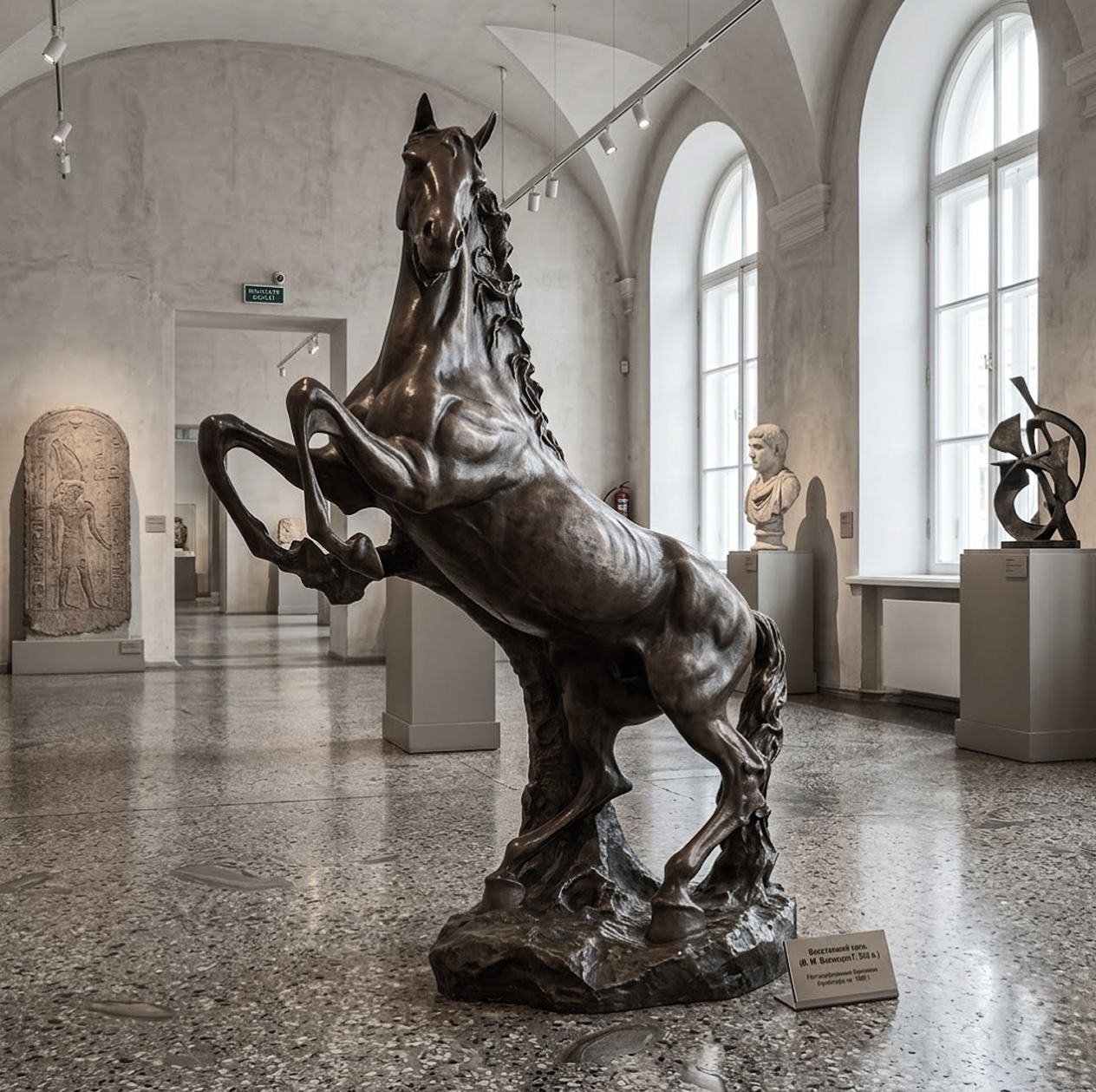
Every cast begins as a loss. The wax model is destroyed to make the bronze possible — the original must be given up before the permanent thing can exist.
The Laocoön has been copied, measured, plastered and argued over for five centuries. It was unearthed in Rome in 1506 and identified almost immediately; Michelangelo is recorded among the first to see it. The marble group, attributed to the Rhodian sculptors Agesander, Athenodoros and Polydorus, has been held by the Vatican Museums ever since.
What draws us back is not the anatomy. It is the decision the sculptors made to hold the figure at the instant before collapse — not the struggle, not the defeat, but the breath between them. That is the hardest moment to carve and the only one worth carving.
This study translates that decision into bronze and into real-time rendering. The alloy is worked to a semi-polished state: reflective enough to carry a moving light, matte enough to keep the form readable. Roughness is held at 0.42, metalness at 0.92 — values chosen by eye, then fixed.
The result is a piece that is never seen the same way twice. The light moves because you move. What you are looking at is not a photograph of an object; it is the object, lit again every frame.
Bronze does not remember the hand that shaped it. It remembers the heat. — Foundry note, undated
Nine studies of surface, tension and edge. Read them as a set — the relationships between the plates carry more than any single frame.
The form is built in wax over an armature. Everything that will exist in metal must first exist in a material soft enough to be wrong.
The wax is encased in a ceramic shell and fired. The wax runs out and is gone — the mould is now a void in the exact shape of the work.
Bronze enters the shell at roughly 1,150 °C. The pour takes seconds; the cooling takes a day. Nothing can be corrected in between.
The shell is broken away, sprues cut, seams chased back by hand. Heat and chemistry bring up the patina. Only then is the surface polished back to 0.42.
Eight casts, two proofs. Each is numbered at the base and accompanied by the foundry record and a certificate of the digital twin.